Oh, happy, frabjous day! WordHappy is moving to a shiny, new location.
Come join me with all the continued celebrations of fabulous writing at my very own website: http://toddiedowns.com/blog/
See you there!
Oh, happy, frabjous day! WordHappy is moving to a shiny, new location.
Come join me with all the continued celebrations of fabulous writing at my very own website: http://toddiedowns.com/blog/
See you there!
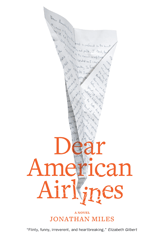 The year is off to a good start! I just finished reading my first novel of 2009, and loved every word of it. Jonathan Miles‘ Dear American Airlines is a terrific read. I confess, even though the novel showed up on a number of Best of 2008 lists, I was leery about whether a true novel could be contained within the comic conceit of an angry rant letter to American Airlines. Trust me, it can.
[Random association tangent: I tend to read most of my books via that most underutilized of places, the library. I put a number of the books called the Best of 2008 on the reserve list, and about FIVE of them have shown up for me at the exact same time. Has that happened to anyone else? Thus, expect a number of book posts for the next couple weeks as I read as fast as my fingers can turn the pages.]
The premise of the book is simple: Bennie Ford is stuck in Chicago’s O’Hare airport, about to miss the wedding of his heretofore-estranged daughter, and full of pent-up fury, begins to write the powers that be at American Airlines a letter. He asks:
So talk to me. Did banal old greed induce you to overschedule your flights, a la bank robbers unable to stop stuffing their bags despite the wails of nearing sirens? . . . Or do you plan so tightly and rigidly that the delay of one plane in, say, Dallas can cause a monumental backup akin to a stalled tractor-trailer on the George Washington Bridge at 8:30 am? Or, similarly, are airlines like yourself susceptible to something like the Butterfly Effect, so that a delay caused by a pickled passenger trying to board an early-morning flight in Ibiza can provoke a chain reaction, with delay piling upon delay, and then cancellation upon cancellation, until poor Chicago O’Hare – the sacrificial goat of air travel – is shut down completely?
But the genius of the book is that Miles manages to combine Ford’s extremely funny perspective with a tragic history of his own making; and then layers the story with yet another story within a story of the Polish novel Ford is translating, reinforcing the tragicomic air of the downtrodden hero. The language is lush and dense, and even the cameo characters are rendered fascinating from Ford’s eyes. It is a fantastic book and a perfect way to start out the year. If you experienced lengthy waits in airports over the holiday season, however, you might want to hold off reading it for a month or two.
 Well, the quantity of responses was a little disappointing, I admit. BUT the quality of the responses was anything but. Each response I got for the “Best of” categories listed warranted either an immediate “Oh, yeah” or an “Ooh, I have to check that out” from me. So kudos to the respondents who were nice enough to participate.
And now, the list:
Best Fiction:
Bestseller by Keith Latch: A horror novel in e-book form, this was an area of unplumbed depths for me. Thanks for eBookguru for the recommendation.
The A Song of Ice and Fire series, by George R.R. Martin: This recommendation for this epic fantasy series also comes from eBookguru.
Best Non-Fiction:
Three Cups of Tea, by Greg Mortenson and David Oliver Relin: Although technically published in 2006, reader Jill read it in 2008 and loved it. I also read it in 2008 and was utterly blown away by the story, uncomplicatedly told, of Greg Mortenson’s journey from mountain climber to advocate for promoting girls’ education and literacy through his Central Asia Institute organization.
Best Music:
Everything That Happens Will Happen Today – David Byrne and Brian Eno. Reader Pam sums it up when she calls it “some yummy, brainy, infectious popaliciousness!”
Best Movies:
WALL-E (story by Andrew Stanton and Pete Docter, screenplay by Andrew Stanton and Jim Reardon): eBookguru thought this was one of the best films of 2008, and I have to agree. How does a film with so few words qualify as great writing? From the story, which transcended time and genre to transport kids and grown-ups alike.
Rachel Getting Married (screenplay by Jenny Lumet): Reader Jill voted for this film as one of the year’s best, because “I loved the characters who play against type.”
Now, for all you readers who perhaps partook of a little too much eggnog or were busy having family time, and didn’t get the chance to put your two cents worth in, I will still accept your recommendations! It is never too late (unless of course you’re writing about something from 2009, in which case it will have to wait).
 Now, you know and I know that these next few days are going to be a haze of wrapping paper and too much food. And no matter what holiday you celebrate, the fact remains that almost everything will be closed – and if you’re getting hammered with snow like much of the country – you don’t want to go out anyway.
So reflect – ponder, if you will – on your top-of-the-line choices for the best of 2008. What movies did you see that knocked your socks off? What music did you listen to and actually notice the words? What books did you read that made you stay up way past your bedtime? These are the things I want to hear about.
I will be taking your choices in the areas of:
The “Other” category is for anything else that gave you goosebumps that somehow isn’t included in the above. Please post a comment with your recommendations below. I’d love it if you’d forward this post to your friends as well, so we can get even more participation.
I’ll take comments up until December 31st. Then I’ll compile a list of everyone’s choices and make it the first WordHappy post of 2009!
Merry Christmas, Happy Hanukkah, Happy Kwanzaa, and Best wishes to you all!
 I watched Stephen Colbert’s A Colbert Christmas: The Greatest Gift of All last night, and today, every time I think about the show, it still makes me laugh. From start to finish, the show had an inspired lunacy that managed to mock Christmas specials without mocking the holiday itself. And oh, my, is it funny. At one point, I was so helpless with laughter that my spouse asked me if I needed a Heimlich maneuver.
‘Cuz here’s the thing. The show is filled with song, with lyrics to all written by David Javerbaum. And the songs skewer virtually every genre out there. There’s a patriotic country Christmas song, “Have I Got a Present for You,” sung by Toby Keith:
Christmas is as American as apple pie
It’s a late December version of the Fourth of July
And they may go by a different name
But Uncle Sam and Santa Claus are one and the same
Then, Willie Nelson, dressed as a wise man (!), sings a song that is so pretty that, until you hear the chorus, you would swear belongs in the canon of classic Christmas songs. But then you hear the words and you know that it must never be so (except in NORML households):
And like the child born in this manger
This herb is mild yet it is strong
And it brings peace to friend and stranger
Good will to men lies in this bong
There is also a lovely duet between Colbert and Jon Stewart, “Can I Interest You in Hannukah?” But my absolute favorite, the one that prompted the Heimlich offer, is the sexy ode “Nutmeg,” sung by John Legend. Probably not one to sing in front of the wee children:
Girl, I’m going to rock you like a cradle
You lick the nutmeg off my ladle
It’s pure, it’s refined
And it’s ready to grind
Nuttiness this good does not come around often. If you missed this Comedy Central special, don’t be sad. It will show again on Christmas day.
I will never drink eggnog again with the innocence I once did.
 All I want for Christmas is world peace, an end to homelessness, some cute ankle boots that will fit over my high instep, and a really good 2009 television season.
But if you’re not shopping for me, and you need some tried-and-true gifts for people who know the power of words, I can help you out. Even better: most of these gifts fall in the $25 and under range. Disclaimer: I carry no affiliation with any shopping powerhouse like Amazon or Target or anyone, so I’m not going to include links to these places. You will have to do a little of that work yourself. Sorry.
BODACIOUSLY BRILLIANT BOOKS
The Likeness by Tana French: For mystery lovers, this is the jackpot. This is the book that makes you call in sick to work so you can read more of it. Cassie Maddox, a former undercover cop, gets thrown into the investigation of a woman’s death – a woman who bears the name of her old undercover identity and who could be her own twin. French is an outrageously good writer, and I could not find a false step in the intricate plotting of this novel.
State by State: A Panoramic Portrait of America, edited by Matt Weiland and Sean Wilsey: This book is for the armchair traveler with a taste for fabulous writing. The editors assigned writers of reputation with varied styles, such as Ann Patchett, Tony Bourdain, and Sarah Vowell to contribute essays on every state in the union. The result is a smorgasbord of delicious writing that gives a real sense to the place (not all of it complimentary, incidentally). I’m only a third through my copy; it must be read in small doses, like eating flourless chocolate cake. Are you hungry yet?
Run, by Ann Patchett: In a season that revolved around politics, this quiet novel managed to combine politics, family, and race in an enormously moving and engaging way. It may not be as showy as Patchett’s Bel Canto, but it may be her best work yet.
DIVINE DVDs
For the discerning couch potato in your life, you can’t go wrong with these picks:
Mad Men, Season One: Time travel back to the early 60s when advertising was king, and people smoked and patted women on the behind and never had a second thought about it. It’s a mad trip, almost Shakespearean in its psychology, with Don Draper as its tortured Hamlet. Great writing with an obsession with detail makes this a must-see.
State of Play: This BBC miniseries aired in 2003, but the DVD was just released in 2008, so technically, it counts. And a darn fine thing, too, since this was great drama. The series follows journalists of The Herald as they try to uncover the story behind the death of a young political researcher who may have been involved with a high profile Labour MP. The plot crackles, and the acting by terrific performers like James McAvoy, Bill Nighy, John Simm, and Kelly Macdonald, makes this a drama that doesn’t leave your consciousness easily.
The Wire, The Complete Fifth Season: Since no one apparently watched this other than me and about 10 other people (yes, still bitter about that), what better way to catch up on the best series in the history of television – SERIOUSLY – than by picking up this DVD. Season Four was probably its best, but its fifth and last season still packs a powerful punch. Actually, DVD may be the ideal way to watch this series and really appreciate its attention to story and detail.
SINFULLY STUPENDOUS CDs
Finally, a few picks for the music lover:
Break Up the Concrete, The Pretenders: This CD is filled with songs you would swear that Chrissie Hynde wrote and recorded years ago, they have such a timeless classic feel. Add a driving beat and it’s a keeper.
Rattlin’ Bones, Kasey Chambers and Shane Nicholson: Australian Kasey Chambers has been one of the most distinctive voices to emerge on the folk scene in many years. This latest CD, collaborated on with her husband Shane Nicholson, is an addicting listen.
Happy Holidays, everyone!
 I just saw a commercial last night for the upcoming season of HBO‘s Flight of the Conchords, and I was filled with a glee that has been, sadly, almost entirely absent this television season. This show is a big part of why I still have an HBO subscription, truth be told. It’s that good.
Flight of the Conchords follows New Zealand’s (self-billed) 4th most popular digi-folk parody duo Jemaine Clement and Bret McKenzie as they try to find success in New York City. Aided by their manager and New Zealand cultural attache Murray (Rhys Darby), adviser Dave (Arj Barker), and single obsessed fan Mel (Kristen Schaal), they achieve what New Zealanders might consider success (one of the running gags of the series addresses the lowered expectations of Kiwis).
I’d first heard Flight of the Conchords on the radio, where I had to pull over while driving because I was laughing so hard at their song “Business Time,” which deals with the nuances of the scheduled Wednesday night intimacies:
Conditions are perfect for making love.
You turn to me and say something sexy like, “I might go to bed. I’ve got work in
the morning.”
I know what you’re trying to say, baby.
You’re trying to say “Aww, yeah. It’s business time.”
What the HBO show managed miraculously to do was to take that same sense of low-key absurdity and translate it into a half-hour comedy. Since the show isn’t overpopulated with characters, it can exploit them by letting them play out silly situations extremely seriously, so that the dialogue sounds as if it could come out in one of their songs:
Murray: Be careful with it. Don’t stand next to any big magnets.
Jemaine: Why would I stand next to a big magnet?
Murray: I don’t know what you do in your personal life.
See what I mean? Brilliant.
The new season of Flight of the Conchords starts January 18, 2009 on HBO. If the second season is even half as good as the first season, it’ll be the best show on television.
 I have China on my mind.
Why? Well, for one, I’m traveling there tomorrow and just finished stuffing a suitcase full of everything I might need. Which, on a housekeeping note, I must tell you that while I am gone, there will be no WordHappy posts. Do not fear that I have abandoned ye faithful few. I shall return with all sorts of yummy things I got to read and hear and watch on the plane. Marathon Spongebob episodes on DVD, anyone?
The other reason I have China on my mind is because I recently finished an enormously good book chronicling three generations of women in China, beginning with the early twentieth century. Wild Swans: Three Daughters of China, by Jung Chang, is a book that needed to be written, and could only have been done so by her. It is the story not only of her family, but through a century of Chinese history so epic that it boggles the mind that it could be contained in only one hundred years.
The story begins with Chang’s grandmother, who in 1924 becomes a concubine to a general in Peking, during a time when China is mostly unified from the Kuomintang under Chiang-Kai-Shek. Her daughter, Chang’s mother, comes of age as the Communist Party is rising in China, marries a Party official and becomes one herself. The reader watches as she, along with the rest of China, idealistically follows the teachings of Mao Zedong, only to be persecuted and detained during Mao’s campaign to suppress counter-revolutionaries. Then finally there is Jung herself, who spends much of her childhood entrenched within the Cultural Revolution. It is she who sees China emerge as a global entity, meeting her first foreigners in 1975 and winning a scholarship to Britain in 1978.
Wild Swans is a fascinating, heartbreaking, and thought-provoking tale.
 As I’ve posted before, regardless of one’s politics or feelings about the outcome of our 2008 Presidential election, there’s one thing that can be said about President-elect Barack Obama: the man can write.
The first sentences of his remarks on election night, as people screamed and sobbed and hugged each other, gave the inspiration that so many of his speeches have evoked:
If there is anyone out there who still doubts that America is a place where all things are possible; who still wonders if the dream of our founders is alive in our time; who still questions the power of our democracy, tonight is your answer.
It’s the answer told by lines that stretched around schools and churches in numbers this nation has never seen; by people who waited three hours and four hours, many for the very first time in their lives, because they believed that this time must be different; that their voice could be that difference.
It’s the answer spoken by young and old, rich and poor, Democrat and Republican, black, white, Hispanic, Asian, Native American, gay, straight, disabled and not disabled – Americans who sent a message to the world that we have never been a collection of Red States and Blue States: we are, and always will be, the United States of America.
It surprised me not one whit to be moved by his speech on election night. But what has pleasantly surprised me is how many essays I have read since Tuesday night that have equally moved me. All of the excerpts that follow invoke the same pride, inspiration, and love of country of Obama’s speeches:
The Washington Post columnist Eugene Robinson, in his essay “Morning in America,” wrote:
Yet something changed on Tuesday when Americans — white, black, Latino, Asian — entrusted a black man with the power and responsibility of the presidency. I always meant it when I said the Pledge of Allegiance in school. I always meant it when I sang the national anthem at ball games and shot off fireworks on the Fourth of July. But now there’s more meaning in my expressions of patriotism, because there’s more meaning in the stirring ideals that the pledge and the anthem and the fireworks represent.
Garrison Keillor had this to say in his column for The Chicago Tribune, “Advice for the Happy Couple”:
A golden November day under a blue sky and an air of sweet amiability at the polls and at the end of the day, we elected the right guy, no doubt about it. Yes, we can and we did. A nation spread its wings and achieved altitude.
Maria Niles, in her PopConsumer blog, wrote:
My 21 year-old niece voted in her first presidential election. She will never know a different possibility – a time when only white men could lead this country. Where black people where considered anything less than fully and completely American even though this country was built on our backs and with our blood. My 94 year-old grandmother, our matriarch, who has been the keeper of our family’s oral history of slavery and escape is alive to see this moment. My cousin who traveled from the north to the south to be a freedom fighter in the civil rights movement is witnessing this history. My mother who spent days and months volunteering and making phone calls to participate in democracy and help make history is witnessing this moment. My father who fought for the country he chose to become a citizen of has been transformed and electrified by this campaign and he is witnessing this moment.
Perhaps Roger Cohen of The New York Times best expresses in his essay “Perfecting the Union” what I am feeling as I read these essays, as well as the words of President-elect Obama: that words matter:
America can mean what it says. It can respect its friends and probe its enemies before it tries to shock and awe them. It can listen. It can rediscover the commonwealth beyond the frenzied individualism that took down Wall Street.
I know, these are mere words. They will not right the deficit or disarm an enemy. But words count. That has been a lesson of the Bush years…
Obama will reinvest words with meaning. That is the basis of everything. And an American leader able to improvise a grammatical, even a moving, English sentence is no bad thing.
 Thought I’d just throw out the factoid that WordHappy is a whopping one year old today! Thanks to everyone who’s tuned in so far. Tell all your friends. I’m still gunning for a gig on EW. Oops. Did I say that out loud?
Seriously, without readers, this wouldn’t be any fun at all. So keep commenting, keep posting, and keep reading. You all are great.

 WordHappy